
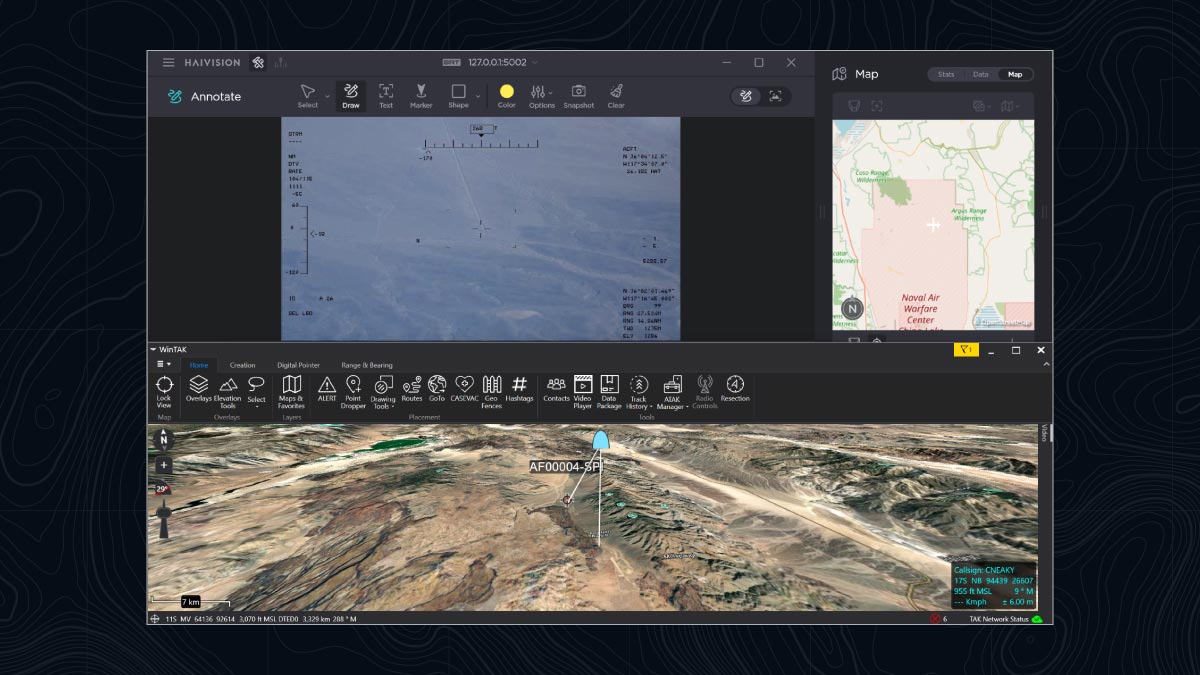
When defense, ISR, and public safety teams need a shared view of personnel, assets, and operational information, they can turn to TAK (Tactical Assault Kit or Team Awareness Kits) to help maintain situational awareness across distributed operations.
Adding live video from drones or unmanned aerial systems (UAS), aircraft, vehicles, cameras, and other sensors provides another layer of context, allowing operators to move beyond seeing where something is happening to seeing events as they unfold. This is particularly relevant to defense and military operations, where video from distributed platforms and sensors can become an important part of the operational picture.
But getting that video from the sensor to TAK, and to other users across the mission, requires a reliable, low-latency video workflow.
The main components of a TAK ecosystem include applications such as Android Team Awareness Kit (ATAK) and Windows Team Awareness Kit (WinTAK), along with TAK Server, which supports information sharing among connected users and systems.
As Haivision Solutions Engineer and ISR video expert Chris Nienke explains:
“At its core, TAK is about keeping teams aware of where people and assets are at any given time. It gives teams a shared map where operational information can come together.”
For organizations already using TAK, live video can add another important source of operational information to that shared picture. Haivision’s ISR video solutions support workflows that connect video capture, processing, transport, and distribution across mission environments.
How Live Video Enhances TAK
Knowing where something is happening is important. Seeing what is happening provides another level of context.
Depending on the mission, teams may need live video from unmanned aerial systems (UAS), manned aircraft, tactical vehicles, fixed cameras, body-worn cameras, or other sensors. Making these feeds accessible alongside geospatial and operational information can help operators verify conditions and better understand events as they unfold.
For an ISR mission, for example, an icon on a map may identify the location of an aircraft or sensor. Full-motion video (FMV) from that asset provides direct visual information about the area being observed. KLV/CoT metadata can add further context, including information associated with the sensor and platform.
These capabilities are central to mission-critical video workflows used across defense and military environments, where video and associated metadata may need to move between sensors, operators, command centers, and analysts.

How Do You Get Video from a Drone or UAS into TAK Workflows?
Getting video into a TAK workflow requires moving the live feed from the drone or UAS through an encoding and transport workflow that makes the video accessible to TAK users. Depending on the operating environment, an operator may access that video through a TAK application such as ATAK or WinTAK.
Protocols such as RTSP and multicast can be used to distribute live video across IP networks. However, when video needs to travel across networks where conditions can fluctuate, Secure Reliable Transport (SRT) provides a more resilient option for reliable, low-latency delivery.
The SRT protocol, which was invented and open-sourced by Haivision, is designed to maintain video quality when networks are affected by packet loss, jitter, or changing bandwidth, making it particularly well-suited for live video over unpredictable networks. These can include low earth orbit (LEO) satellite, traditional satellite, and other wireless IP networks. Available bandwidth and network conditions can change due to factors such as congestion, signal strength, coverage, interference, mobility, and other disruptions that can affect live video.
The same principle applies whether video originates from an aircraft, tactical vehicle, fixed surveillance camera, or other ISR asset. The source and available network may change, but the goal remains the same: deliver usable video and its associated metadata to operators quickly and reliably.
For organizations deploying video across demanding operational environments, Haivision’s ISR video solutions provide technologies for moving mission-critical video from the point of capture through processing and delivery.
Building the Video Workflow Behind TAK
TAK may be where an operator consumes a video stream, but an entire mission-critical video ecosystem can be operating behind it.
A typical workflow can be considered in six stages:
Acquire → Encode → Transport → Process → Distribute → View
Video is acquired from a UAS, aircraft, vehicle, camera, or other sensor and encoded into a format appropriate for the mission and available network. It can then be transported across tactical networks using available connectivity, which may include radio-based IP links, satellite, cellular, private IP, or other communications infrastructure, before being processed or transcoded when necessary and distributed to the applications and users that need it.
Latency can be introduced at every stage of this workflow. Efficient video encoding, low-latency processing, and reliable transport are therefore important when operators need to see events as close to real time as possible.

From UAS to TAK: A Mission Video Workflow
Consider an ISR operation where a UAS is providing live full-motion video and metadata.
A Haivision Makito video encoder can encode the source into a high-quality, low-latency stream while maintaining the metadata required for the mission. From there, the video may need to travel across satellite, LEO satellite, public internet, or other IP-based connections to reach distributed users and locations. When network conditions are affected by limited or changing bandwidth, packet loss, or jitter, SRT can provide reliable, low-latency video transport.
Haivision Kraken can help ensure interoperability and distribution across the workflow, adapting video streams as needed so they can be delivered to different systems, applications, and users across the mission. These technologies form part of the broader Haivision ISR video ecosystem.
Different users can then consume the same operational video in ways suited to their responsibilities. An operator in the field may access the live feed through ATAK, while an ISR analyst can use Haivision Play ISR to view FMV and its associated KLV metadata.
Rather than treating TAK as an isolated destination, this type of workflow allows live video to be distributed to field operators, analysts, and other mission users wherever that information is required.
TAK and Live Video for Public Safety Operations
TAK can also support multi-agency public safety operations where different organizations need to coordinate personnel, assets, sensors, and information across a shared response. Haivision’s public safety solutions support mission-critical video workflows for organizations that need to share visual information across distributed teams.
Consider a major wildfire involving fire departments, law enforcement, EMS, and emergency management. TAK can provide a shared geographic view of personnel and operational information, while live video can help teams move from seeing where a responder or asset is located to seeing what they are seeing.
As Nienke explains:
“You can see where someone is on the map, select that location, and access what they’re seeing in the field. That gives teams another level of context when they’re coordinating a response. In ad-hoc operations, where teams are often working with different information and priorities, combining TAK with live video helps turn that information into something leaders can quickly act on. That added coordination can help teams respond faster and make more informed, accurate decisions.”
Initiatives such as Wildland Fire Team Awareness Kit (WFTAK) demonstrate how TAK-based capabilities can be applied to wildfire response, giving public safety teams another tool for maintaining shared situational awareness during complex incidents.
By combining shared operational information with live video, public safety teams can incorporate visual information into workflows involving distributed responders, assets, and sensors.
Whether supporting an ISR mission or a multi-agency emergency response, the underlying challenge is similar: connecting information from distributed people, platforms, and sensors to create a shared understanding of what is happening.

How Do You View Video Outside TAK?
Not every user involved in an operation needs to consume video through TAK. ISR analysts, for example, may need a dedicated environment for viewing full-motion video and its associated KLV metadata.
This is why video distribution should be considered independently from any single viewing application. The same mission video used within a TAK workflow may also need to be made available to analysts and other users based on their operational requirements.
Haivision Play ISR provides a dedicated environment for viewing low-latency FMV and KLV metadata, giving ISR personnel another way to consume and analyze mission video outside TAK.
This broader approach to video distribution is part of Haivision’s ISR video solutions, which are designed to support mission-critical video workflows across different users, platforms, and operational environments.
Building a More Complete Operational Picture
TAK helps teams establish shared situational awareness, while live video provides additional visual context as events unfold. Making that video accessible requires an underlying workflow capable of efficiently encoding, transporting, processing, and distributing video and metadata.
From operators accessing live video through TAK to analysts working with FMV and KLV metadata, mission-critical video infrastructure helps ensure visual information reaches the people who need it, when they need it.
Across defense and military missions, ISR operations, and public safety responses, the ability to connect video with operational information can provide teams with a more complete view of what is happening in the field.
