
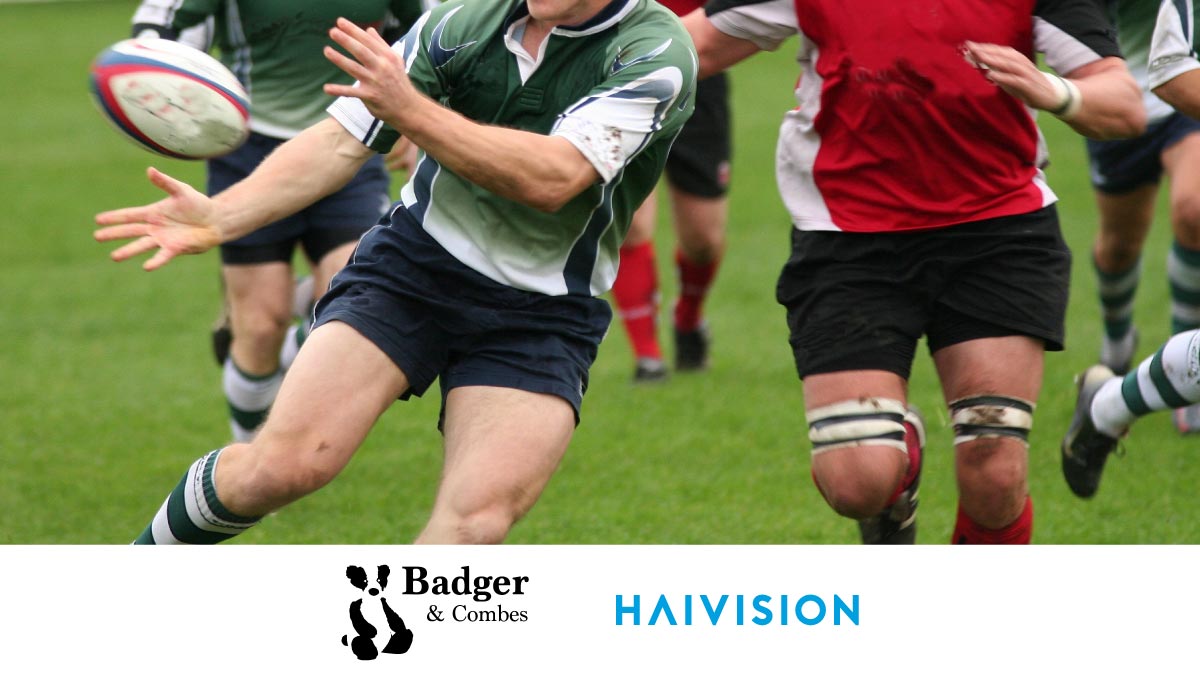
Remotely producing a live global sporting event on the scale of the Dubai Rugby Sevens is no small feat. With hundreds of matches played across multiple locations, a production hub thousands of miles from the venue, and zero tolerance for downtime, delivering uninterrupted live coverage to a global audience is a major challenge. For the 2025 tournament, Badger & Combes took on the challenge of live streaming every single match using a fully remote production workflow built for seamless worldwide distribution.
A Haivision-powered workflow formed the backbone of the production, designed for high scalability, efficiency, and rock-solid reliability. With Haivision’s award‑winning contribution solutions along with the SST (Safe Streams Transport) protocol the team delivered a resilient, continent-spanning broadcast network built to meet the intense demands of live, fast‑paced sports.
About the Dubai Rugby Sevens Tournament
The Rugby Sevens in Dubai is an international tournament that features the top men’s and women’s rugby sevens teams from around the world. Held annually, it’s part of the World Rugby Sevens Series of fast-paced 14-minute, 7-a-side format matches. The tournament is one of the most anticipated events in the series, drawing large crowds and global attention.
In one weekend, 664 competitive rugby matches were played across a sprawling multi-sport venue in Dubai. Every game was captured and streamed live to YouTube, the Dubai Sevens official website, and the official event app.
Rather than deploying a large-scale broadcast set-up close to the venue, Badger & Combes relied on a flexible and lightweight contribution model using Haivision solutions powered by SST. This enabled the live production to be driven from a central hub located in Manchester, England, while the post-production infrastructure operated live in Dubai.
Haivision enables end-to-end live production of every match
On-site in Dubai, Badger & Combes deployed a total of 12 cameras connected to a range of Haivision live contribution solutions across eight pitch locations with video contribution and distribution enabled by the SST protocol.
The main stadium, which hosted the invitational finals, was supported by a Haivision Pro460 mobile video transmitter that handled multiple camera feeds simultaneously through the Pro’s multiview feature. A second Pro460 was positioned at the engineering station, ingesting feeds from three additional pitches alongside an RF camera. This field unit played a key role in enabling real-time bidirectional communications between the Camera Control Unit (CCU) teams in Dubai and the production team in Manchester. Across all the other pitches, seven Haivision Air mobile video transmitters and a Falkon X2 mobile video transmitter were deployed at individual camera positions, providing reliable, low latency live video contribution from each of the games, as well as return feeds so on-site engineers could monitor the action from the other pitches.
A Haivision Air unit was also leveraged to support audio communications and used for file transfer. The team in Manchester was able to communicate with the on-site team in Dubai through the Air, allowing roaming crew members to coordinate the production from over 3,000 miles away. This same infrastructure was used to transfer files, further consolidating production workflows into a single, unified Haivision ecosystem.
All the camera feeds from Dubai were sent over the internet using SST with latency as low as 1.5 seconds, arriving at two Haivision StreamHub receivers in Manchester. From there, the feeds were sent to EVS for replay, graphics, and other post‑production needs before being delivered to digital platforms.
“The Haivision equipment and SST performed brilliantly throughout the entire event,” said Colin McKevitt, Managing Director, Badger & Combes. “Every day, it exceeded expectations and the technology easily and seamlessly integrated into our workflow. I couldn’t have asked for better reliability and performance.“
Beyond distribution, StreamHub also provided the team with recordings of each of the matches. Every incoming feed was recorded as it arrived, creating a backup archive of all the camera footage, which was important for post-event content. The flexibility of the Haivision solutions allowed all teams to have full visibility of the entire production from both sides of the workflow.
A successful large-scale live production fueled by Haivision
Despite the distance between Dubai and Manchester, the camera-to-production workflow delivered latencies of approximately one and a half seconds, enabling effective live switching, replay operation, and real-time communication across continents.
What would once have required large crews and significant on-site infrastructure was achieved through a centralized workflow built on Haivision technology and SST. By the end of the weekend, Badger & Combes had successfully delivered live coverage of all 664 matches with no major technical issues, using a production footprint small enough to fit into just three Pelican cases.
“We arrived on site with just a small number of equipment cases, without the need for a large outdoor broadcast unit or complex production infrastructure. The Haivision equipment was lightweight, easy to deploy, and highly cost-effective, enabling us to deliver a full-scale production with a minimal on-site footprint and significantly reduced operational costs,” said McKevitt.
