

The use of 5G is slowly becoming more prevalent within live broadcast workflows, most notably during last summer’s Olympic Games. France Télévisions joined forces with Haivision to deliver live coverage of the surfing competition via the technology company’s 5G video transmission ecosystem.
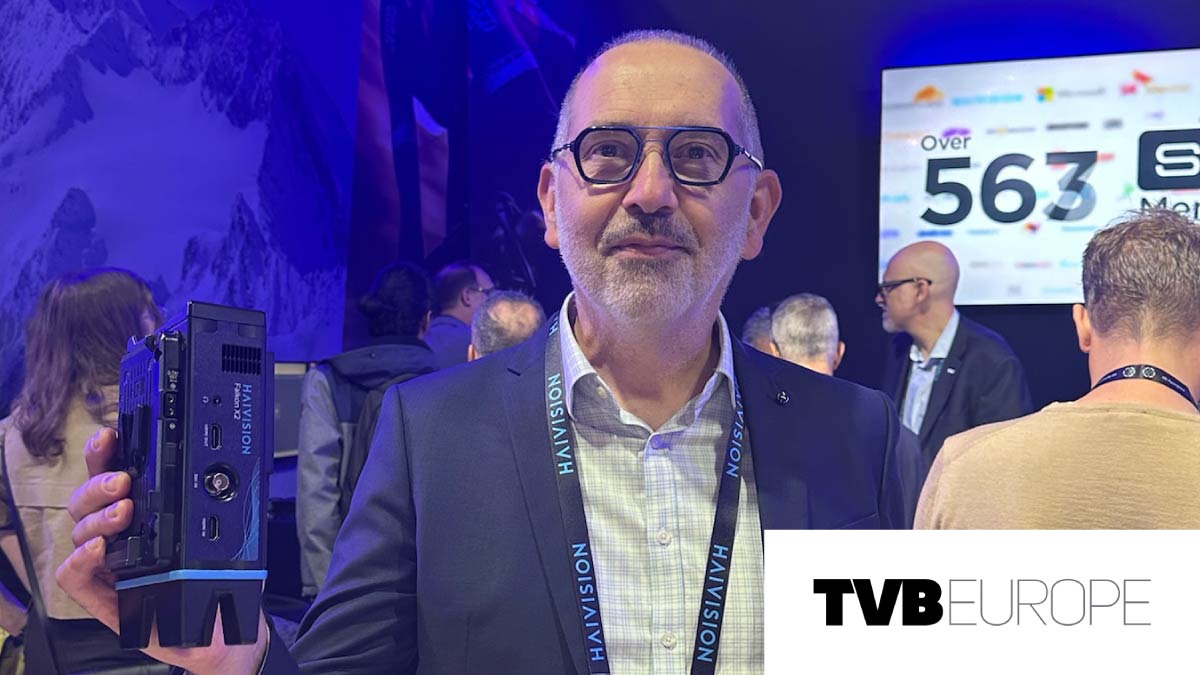
The project will help drive the discussion at the Future Tech panel session, Conquering the Air(waves): Private 5G from Land to See to Sky. TVBEurope caught up with Haivision’s SVP of engineering, Ronan Poullaouec, who will be among the panelists, to discuss the industry’s adoption of 5G, and to look forward to the arrival of 6G.
5G still seems like a ‘nice to have’ rather than a ‘must have’ for many broadcasters. How do you change that opinion?
The evolution of public networks presents compelling opportunities. As 5G standalone rolls out globally, it delivers significantly enhanced bandwidth capacity and can accommodate more users simultaneously. For professional applications, 5G network slicing enables guaranteed bandwidth allocation—a critical advantage for broadcast operations. The development of standards and APIs for time-slot reservations with service guarantees represents a major advancement. Haivision’s ongoing collaboration with public operators to test these capabilities will provide broadcasters and television networks with unprecedented flexibility for ad hoc event production.
Private 5G networks offer another powerful solution. Our extensive live coverage projects during the games in Paris—spanning everything from the Seine opening ceremony to offshore maritime operations in Marseille—demonstrate private 5G’s ability to deliver reliable, ultra-low-latency video transmission in scenarios where public networks fall short. This proves particularly valuable when coverage areas are either geographically challenging for public operators or when public infrastructure prioritizes general consumer traffic over broadcast requirements.
The technology’s transformative impact becomes evident when broadcasters realize they can position wireless cameras on water, in aerial locations, or at remote vantage points previously inaccessible with other technologies—all while maintaining broadcast-quality standards. At this point, 5G transitions from being merely an option to becoming an operational necessity.
Our 2025 Broadcast Transformation Report validates this shift: 76 per cent of broadcasters currently using cellular networks have adopted 5G, primarily citing enhanced bandwidth and reduced latency as key benefits.
How soon do you think 5G will become an industry standard along the lines of cloud or IP?
5G has established itself as the industry standard for wireless camera-based audiovisual production. The economic viability of 5G-based production represents a crucial factor driving widespread adoption. Beyond cost-effectiveness, both public and private 5G networks deliver the operational flexibility broadcasters demand through rapid, streamlined deployment of production solutions. The IP advantage becomes particularly apparent in remote production configurations, where broadcasters achieve significant cost reductions while maintaining quality standards.
Large-scale deployment capabilities have been proven through real-world applications. Our recent customer implementations and accelerator project initiatives demonstrate that private 5G can scale effectively in high-pressure live production environments. Broadcasters are actively incorporating this technology into sports coverage, news operations, and major event broadcasting, capitalizing on 5G’s superior bandwidth, reliability, and mobility compared to alternative network solutions.
This trajectory suggests 5G will achieve foundational status alongside IP and cloud technologies in the broadcasting ecosystem within the coming years.
What about 6G, when do you think we should start considering that for broadcast workflows?
While 6G technology remains in development with commercial deployment still years away, Haivision is actively monitoring its progress.
Our current focus centers on maximizing 5G’s proven capabilities. This technology is delivering tangible results today. This year’s IBC Accelerator project has showcased how private 5G networks can extend broadcast coverage into previously unreachable locations through aerial network deployments, while maintaining the reliability and low latency essential for live broadcasting.
The immediate opportunity lies in fully leveraging 5G’s existing potential. Broadcasters have significant room for growth in adapting their workflows to harness 5G’s complete range of capabilities. Rather than waiting for future technologies, the industry should concentrate on optimizing current 5G implementations to unlock new production possibilities and operational efficiencies.