
Launched in 2019, the IBC Accelerator Media Innovation Programme aims to tackle some of the media and entertainment industry’s most urgent technology and business challenges, including the shift to IP workflows, the use of 5G in production and distribution, the evolution of remote strategies, and more.
The program promotes collaboration and innovation through real-world experimentation and features broadcast industry leaders and content providers as “Champions,” while “Participants”, vendors and solution providers like Haivision, work with them to develop and test new and exciting solutions.
For the 2025 IBC Accelerator program, Haivision took part in the “Conquering the Air(waves): Private 5G from Land to Sea to Sky” project which consisted of three proof of concepts (PoCs) which took place last summer. After successfully powering the coverage of the coronation of King Charles from a land-based 5G private network, as well as the games in Paris 2024 from a sea-based 5G private network, Haivision and its partners were looking to take 5G to the skies and provide broadcasters with even more versatile ways to capture content and bring audiences closer to the action.
Keep reading this post to learn about the role Haivision played in the first PoC that took place in Italy with Radiotelevisione Italiana (RAI), France Télévisions, Neutral Wireless, and Eutelsat, as the team set out to test how an airborne 5G-powered production workflow can improve flexibility and reduce complexity for broadcasters while still providing strong network connectivity.
The challenges of an airborne private 5G network
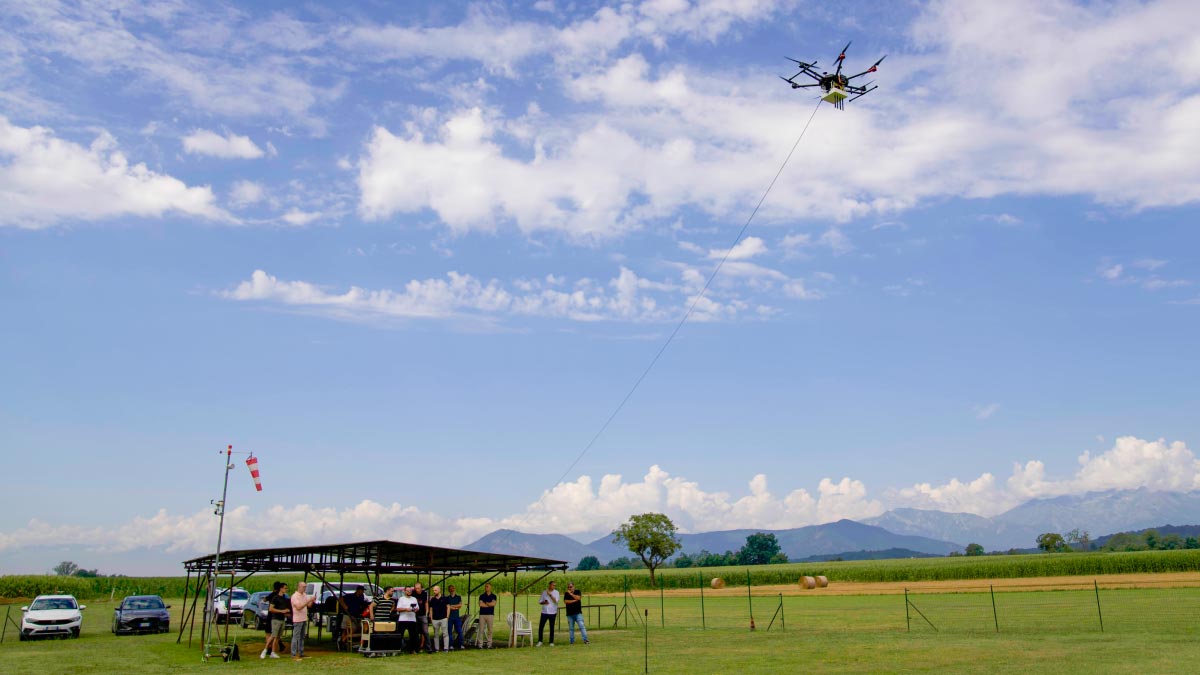
For the first trial in the IBC Accelerator project, the Haivision team and project partners were on location in Italy to create an airborne private 5G cell using a tethered drone and a lightweight n77 radio head.
There were several challenges for the team to overcome even before taking to the air. These included navigating the complexity of spectrum regulations, adhering to strict drone flight zone restrictions, ensuring reliable backhaul connectivity, and monitoring weather conditions.
Once those were solved, one of the biggest production challenges was getting a 5G cell into the air attached to an aerial platform that was sturdy enough to hold it, while still light enough to remain in the air and provide connectivity to devices on the ground.
For the drone to fly, the team needed to keep its weight under 110 pounds (50 kilos) while keeping it tethered to a power cable to ensure there was enough flight time to conduct the test.
A collaborative and innovative Haivision solution takes 5G to the skies
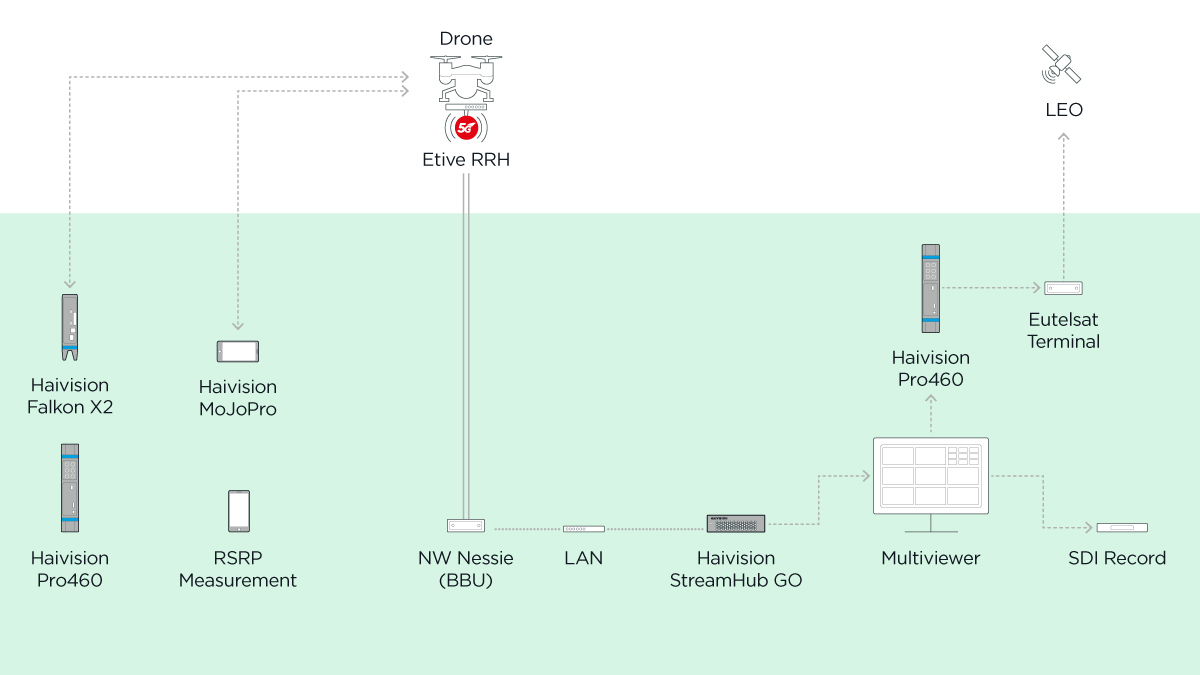
The tethered drone was launched up to 50 meters in the air and provided private 5G connectivity to cameras on the ground within a designated drone flying zone. Using this aerial-based private 5G network, a Haivision Falkon X2 5G mobile video transmitter, a Haivision Pro460 field unit, and smartphones equipped with the Haivision MoJoPro camera app successfully sent ultra-low latency live video to the central production center
A Haivision StreamHub receiver located on-site combined all the live feeds as a single multi-viewer video which was then retransmitted over a Low Earth Orbit (LEO) satellite network link using a Haivision Pro460 for distribution to the cloud.
The airborne 5G network allowed the ground-based infrastructure to contribute multiple live video feeds with excellent quality at even better-than-expected range, making the first PoC a massive success. This trial offered valuable insights into performance, range, and stability of airborne private networks, especially in dynamic environments.
Haivision’s suite of mobile live contribution solutions, including the ultra-low latency Falkon X2, were key to demonstrating how 5G-based contribution workflows can be powered from anywhere, including the skies. For distribution, Haivision StreamHub continued its proven track record of providing an effective method of managing and routing live feeds across complex network environments.
A successful test flight for the future of 5G
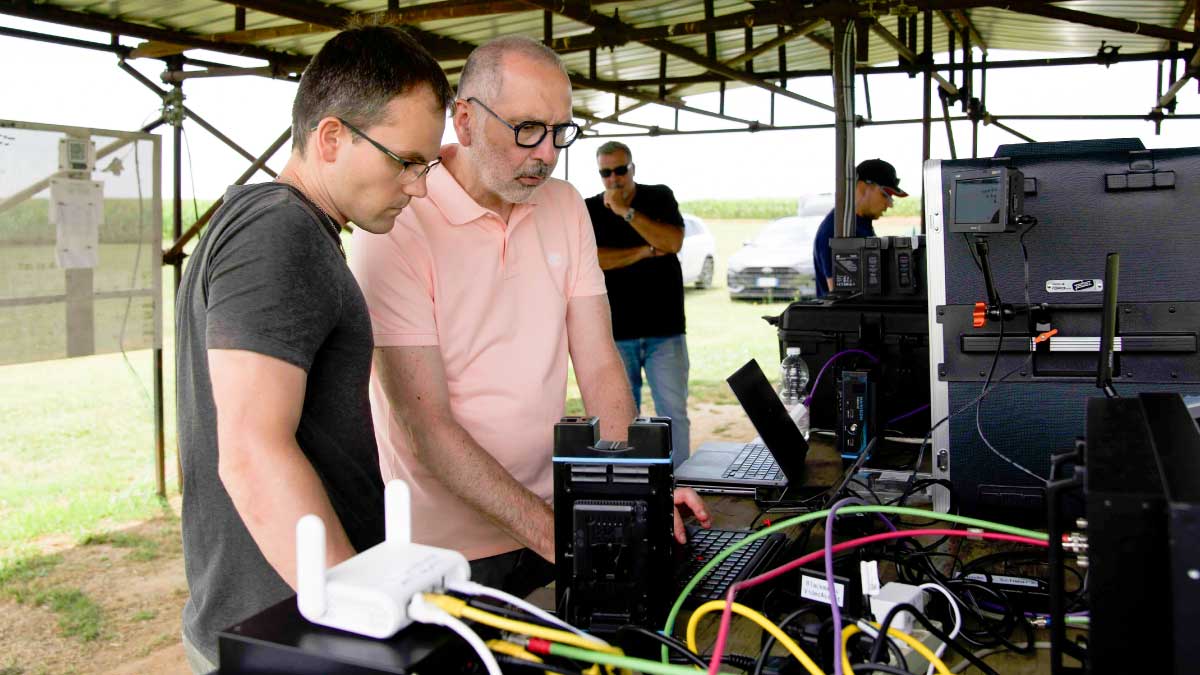
The success in Turin displayed that unconventional methods of deploying a private 5G network can provide unique, cost-effective, and greener ways to cover dynamic events like mountain races, music festivals, or breaking news stories. These successful PoCs prove that the potential for flexible, rapidly deployable, high-quality broadcast infrastructure is closer to being a reality than ever before.
“For several years, RAI R&D has been engaged in the analysis of private 5G mobile networks to support television production. In this trial, RAI identified a suitable location near Turin to host the POC, providing the frequencies required for the use of the airborne private 5G network and the technical staff for integrating the cell with the drone, as well as for carrying out the first preliminary tests. RAI sees each of these tests as a significant milestone on the path to adopting this technology in production — a breakthrough that we look forward to embracing in the very near future,” said Giulio Stante, R&D engineer at RAI.
For Haivision and the other participants, the IBC Accelerator Programme provided a platform that challenges R&D teams to develop next-generation technologies that enable broadcasters to push creative storytelling beyond the limits of restrictive infrastructure and coverage zones.
