
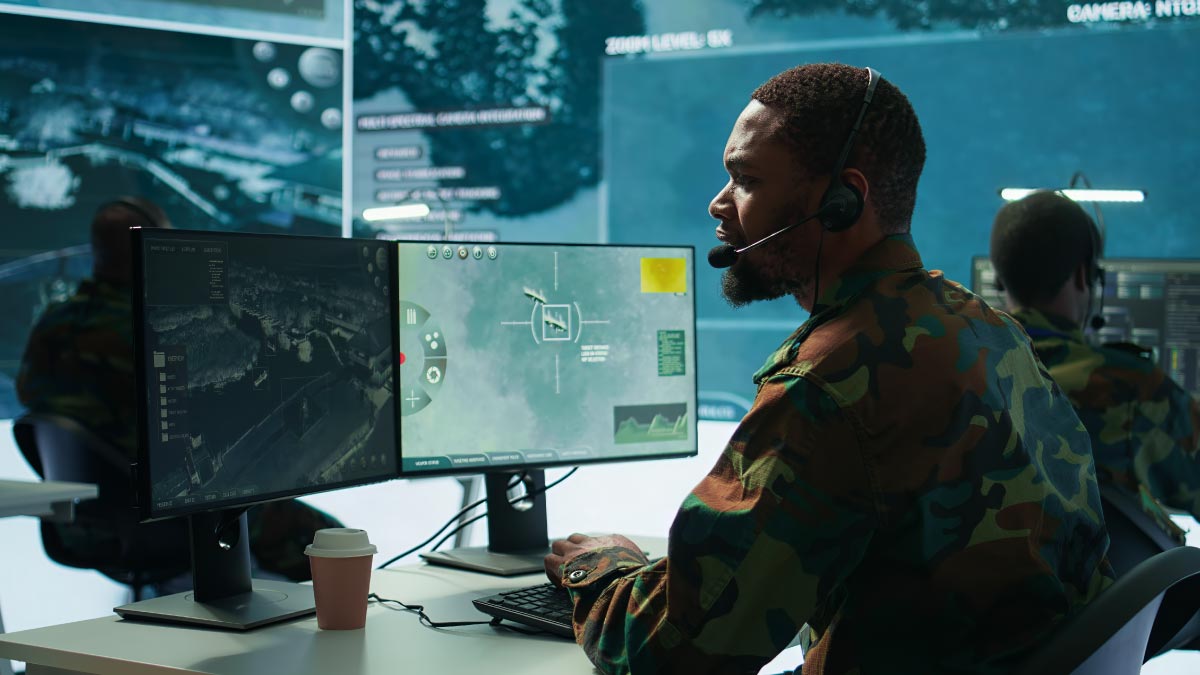
For public safety agencies and defense and military organizations, the challenge is not gaining access to video and data. It is managing the volume, velocity, and complexity of that information when operational pressure is at its highest.
Operation and command centers are expected to ingest dozens, sometimes hundreds, of live sources simultaneously. Video walls play a critical role in how teams assess situations, coordinate responses, and maintain command and control. The real challenge is ensuring those video walls support decision-making rather than adding friction.
Modern video wall solutions exist to address this exact problem. They bring structure, context, and control to content-heavy environments so teams can focus on action.
The Reality of Content Overload in Command Centers
Public safety and defense operations rely on a wide range of live and recorded sources, including:
- Body-worn cameras and drones
- Traffic systems, fixed surveillance, and license plate readers
- UAV, aircraft, and vehicle-mounted video
- Tactical ISR systems
- Intelligence, mapping, and geospatial tools
In real-world operations, this content is rarely static. Sources change, priorities shift, and teams need to adapt quickly without interrupting the flow of operations.
When video walls are difficult to scale, slow to update, or dependent on manual workflows, they become a bottleneck. Operators spend time managing layouts instead of assessing situations. Decision-makers lack a consistent operational picture. Collaboration becomes harder than it needs to be.

What Video Wall Solutions Are Expected to Deliver Today
In modern operation and command centers, video walls are expected to:
- Maintain real-time situational awareness
- Support rapid incident and threat assessment
- Enable effective command and control
- Improve coordination across agencies and teams
- Reduce operator workload during high-tempo operations
- Operate securely and reliably in 24/7 environments
Meeting these expectations requires more than displays and processors. It requires a video wall solution designed around operational workflows.
Haivision Command 360: Designed for Operational Reality
Haivision Command 360 is a complete video wall solution built for mission-critical environments where reliability, security, and speed matter.
Command 360 enables public safety, and defense and military teams to securely visualize live video and operational data from virtually any source and present it in a shared, flexible operational view. Recent updates to Command 360 focus on simplifying deployment and day-to-day operation while preserving the capabilities teams rely on.
“Over the past year, the focus for Command 360 has been on taking an already feature-complete platform and making it significantly easier to deploy and integrate. This has reduced deployment complexity and allowed the platform to operate more easily within customer networks.” — Aaron Leiker, VP of Operations Centers, Haivision
This approach reflects what customers are asking for. More sources, more flexibility, and fewer barriers to integration. Rather than forcing teams into rigid layouts or complex configuration workflows, Command 360 is designed to support how operators actually work under pressure.
Built for Teams That Cannot Afford Delay
In public safety and defense operations, decisions are made in real time, often with incomplete information and high consequences. Video walls must support that reality.
Haivision Command 360 is designed to help teams manage content overload, maintain situational awareness, and act with confidence. It reflects an understanding of how modern command centers operate and the pressures they face every day.
