
ISR Video Encoding Explained for Low Latency Operations
In military and defense operations, ISR video is not just a feed. It is a decision-making tool. The same is increasingly true in public safety, where live video from drones, body cameras, traffic systems, and fixed surveillance feeds directly informs how incidents are assessed and managed.
Whether in a battlefield or across a city, the value of that video depends on how quickly and clearly it reaches the people who need it.
ISR video encoding sits at the center of that process. It determines how video is compressed, transmitted, and ultimately experienced in a command center or in the field. When encoding is done well, operators see what matters in real time. When it is not, delays, artifacts, and dropped frames introduce friction at exactly the wrong moment.
What ISR Video Encoding Actually Does
At its core, encoding takes raw video and compresses it into a format that can be transmitted over a network. Raw video is far too large to send efficiently, especially in field conditions or across shared public safety infrastructure.
The challenge is not just compression. It is doing so in a way that preserves clarity while keeping latency as low as possible. Every encoding decision directly impacts how usable that video is once it reaches operators. If detail is lost, analysis suffers. If latency increases, timing suffers. Both affect outcomes.
Why Ultra Low Latency Matters
Latency is not just a technical specification. It is an operational risk.
A delay of even a few seconds creates a gap between what is happening and what operators are seeing. In military ISR operations, that affects tracking, coordination, and response timing. In public safety, it can delay how quickly a team understands a situation, whether that is a developing incident, a suspect in motion, or a search and rescue effort.
The expectation is simple. Video must reflect what is happening now. Not moments ago. That is why ultra-low latency encoding is essential. It ensures that decisions are based on current information, not delayed interpretation.
Compression, Quality, and Bandwidth Tradeoffs
Encoding always involves tradeoffs. Higher quality video requires more data. Lower bandwidth reduces network strain but can impact clarity. Reducing latency limits how much compression can be applied.
In real-world operations, the priority is rarely perfect image quality. It is usability. A slightly reduced image that arrives instantly is far more valuable than a pristine image that arrives too late to act on.
This is true across both defense and public safety workflows. Whether monitoring a drone feed over a remote area or coordinating response across a city, timeliness consistently outweighs visual perfection.

The Reality of Constrained and Shared Networks
Unlike controlled environments, ISR and public safety operations rarely benefit from stable connectivity.
Bandwidth fluctuates constantly. In defense scenarios, this is driven by terrain, mobility, and contested environments. In public safety, it is often the result of shared infrastructure, especially during large-scale incidents where network demand spikes.
Historically, teams addressed this by setting a fixed, conservative bitrate. The goal was to maintain a stable stream, even if it meant sacrificing quality. While effective for consistency, this approach often led to underutilized bandwidth and limited visibility.
As operational demands increase, that compromise becomes harder to justify.
Dynamic Bitrate and Adaptive Encoding
Modern encoding has evolved to better reflect the realities of the field. Dynamic bitrate allows video streams to continuously adjust based on available network conditions.
Instead of locking into a predefined bitrate, the encoder responds in real time. When bandwidth is available, quality increases. When conditions degrade, the stream adapts to maintain continuity.
This shift changes how teams approach reliability. Rather than choosing a safe baseline and staying within it, systems can now make better use of available capacity without risking disruption.
For public safety, this is especially important during high-pressure events where networks become congested. For defense, it supports operations in environments where connectivity is unpredictable or actively contested. In both cases, the outcome is the same. Video remains available, consistent, and usable.
Encoding at the Edge
Another important shift is where encoding takes place.
By moving encoding closer to the point of capture, whether on a UAV, in a vehicle, or within a mobile unit, systems reduce the need to transmit large volumes of raw data. Instead, optimized streams are created immediately and sent across the network more efficiently.
This approach improves latency and reduces network load, but more importantly, it supports faster decision-making. Teams do not need to wait for centralized processing. They can act on video as it is captured and shared.
In both ISR and public safety workflows, this supports more distributed operations where teams are not always in the same location but still require a shared, real-time view.

What to Look for in an Encoding Solution
When evaluating ISR encoding solutions, the focus should be on how well the system performs under real-world conditions, not just in ideal scenarios.
Ultra-low latency is essential, but it must be paired with efficient compression that preserves meaningful detail. Adaptability is equally important. Networks are not static, so encoding should not be either. The ability to adjust dynamically ensures that video remains stable and usable even as conditions change.
Finally, reliability across constrained or shared environments is critical. Simply put, the video must arrive, and it must be usable.
From Video to Actionable Intelligence
ISR video encoding is not just about moving data. It is about enabling decisions.
In defense, it supports mission execution by delivering real-time intelligence where and when it is needed. In public safety, it enables faster response, better coordination, and improved situational awareness during critical incidents.
As both environments continue to rely more heavily on live video, encoding becomes a defining factor in operational performance. More sources, more stakeholders, and more complexity all increase the importance of getting it right.
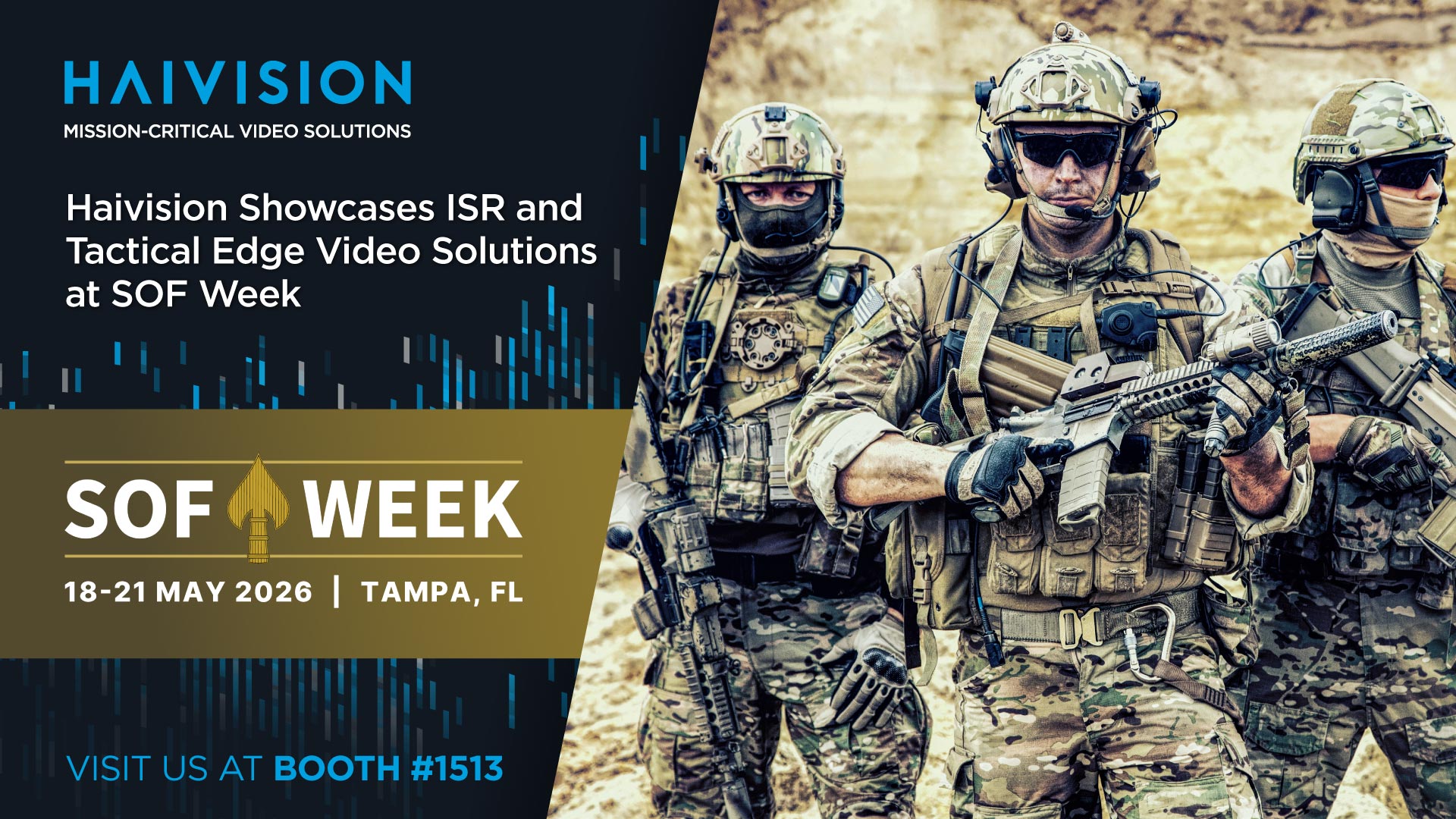
See It in Action at SOF Week 2026
If you are evaluating ISR video technology, seeing encoding performance in action provides valuable context.
At SOF Week 2026, Haivision will demonstrate how ultra-low latency encoding, dynamic bitrate, and real-time video delivery support mission-critical operations across defense, government, and public safety.
It is an opportunity to see how encoding decisions translate directly into operational impact, from the edge to the command center.
